How do you keep employees engaged throughout the year, not just at one-off events?
Keeping employees engaged throughout the year isn't a one-event job.
Team energy changes with business cycles, deadlines, appraisals, new goals, festive seasons, and, inevitably, periods of fatigue. What energizes a team in January may not be what it needs in June.
For HR teams, the challenge isn't simply finding a fun activity. It's figuring out what the team needs at a particular point in the year and choosing an experience that responds to it.
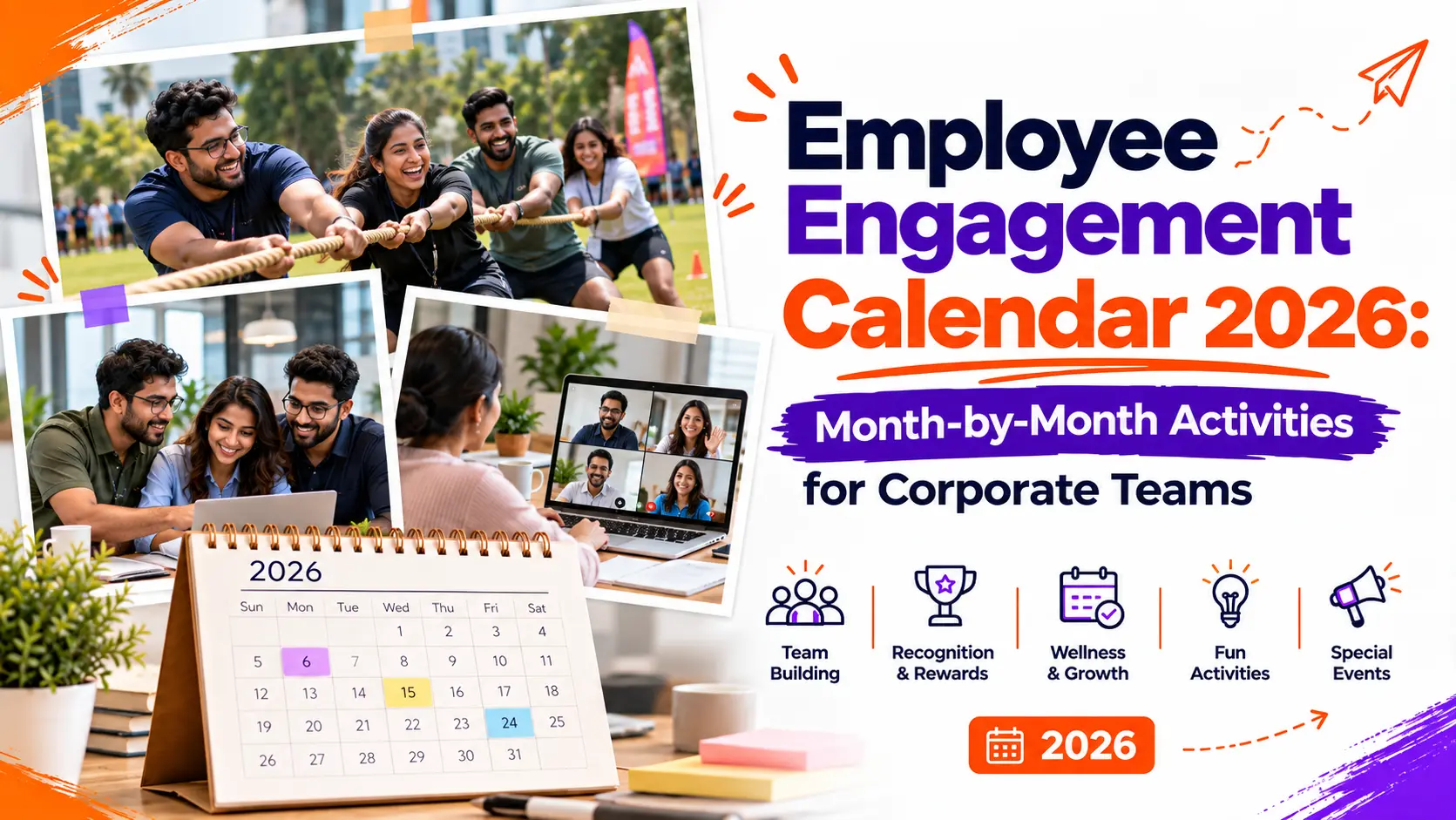
That's why we've put together this employee engagement calendar, mapping different stages of the year to team-building experiences designed around specific team needs.
Think of it as an employee engagement calendar template that HR teams can use to plan Monthly Employee Engagement Activities throughout the year.
These are some of the team-building experiences Prolite curates in-house, keeping common workplace challenges and team dynamics in mind. From communication gaps and disengagement to collaboration, trust and decision-making, each experience is designed with a specific team outcome in mind.
If you're looking for Employee Engagement Ideas beyond the usual celebrations and office games, this calendar offers a mix of high-energy challenges, creative experiences, strategic simulations and collaborative activities.
And you don't have to worry about the execution.
From planning and customization to setup, facilitation and execution, Prolite handles the experience end-to-end, so HR teams can focus on their people while we take care of everything else.
Here are 12 experiences to consider, one for every month of the year.
January
Team need: Rebuild momentum, ownership and accountability
Activity: Bomb Squad
Why now:
January comes with fresh goals, renewed motivation, and a clean slate. It is the perfect time to channel individual motivation into something collective, stronger ownership, sharper collaboration and accountability from day one.
What teams do:
In Bomb Squad, teams race against the clock to defuse a simulated bomb using clues and problem-solving. Every participant has a role to play, and success depends on how well the team communicates, uses individual strengths, and makes decisions under pressure.
What it builds:
Ownership in high-pressure situations
Accountability for individual roles
Strategic thinking under time constraints
Strength-based collaboration
Proactive help-seeking
Why it works for January:
It takes the fresh energy of the new year and turns it into action, ownership, and collective responsibility.
February
Team need: Connection, collaboration and belonging
Activity: Symphony Jam
Why now:
Once the initial rush of January settles, February can be a useful time to focus on how comfortably people collaborate. Teams that know how to listen, participate, and work in sync are better positioned to navigate the busier months ahead. It is a good time to strengthen human connections that make collaboration easier.
What teams do:
Symphony Jam turns the team into a high-energy musical ensemble. Participants create music together, contributing individually while staying connected to the rhythm and the larger group. The experience is less about individual ability and more about listening, participating, and staying in sync with one another.
What it builds:
Active listening and responsiveness
Seamless collaboration
A stronger sense of team belonging
Comfort in group participation.
Collective synchronization
Why it works for February:
It creates a low-pressure environment where people can participate, connect, and experience what it means to create something together.
March
Team need: Focus, adaptability and collaboration under pressure
Activity: Squid Game
Why now:
March often brings Q1 reviews, deadlines, and conversations around the next quarter. Teams may be dealing with competing priorities and increased pressure. A challenge that requires focus, observation, and communication can give employees a completely different way to practice those skills. With pressure building, teams may need more than another discussion about performance; they need a chance to reset, recharge and test how they respond when the stakes are high.
What teams do:
Inspired by the high-stakes challenges of the popular series, Squid Game puts participants through a series of competitive challenges where decisions have consequences, and teams must think on their feet. The experience demands focus, quick reactions, and the ability to adapt as the situation changes.
What it builds:
Rapid decision-making under pressure
Situational intelligence
Sharper instincts and responsiveness
Collaboration when the stakes are high
Sustained focus under pressure
Why it works for March:
Instead of adding to the pressure of the quarter, it creates a different kind of pressure, one where teams can experiment, react, collaborate, and have fun while doing it.
April
Team need: Learning agility, planning and collaborative problem-solving
Activity: Machine Making
Why now:
April brings a fresh business cycle for many organizations. New plans are underway, priorities are being established, and teams are preparing for the year ahead. It is a useful time to get people thinking about how individual actions contribute to a larger outcome.
What teams do:
Machine Making puts teams' DIY skills to the test through a cycle assembly challenge. Participants work with individual components and figure out how to bring them together into one functioning outcome. The completed cycles are later donated to charity, turning a team-building activity into a tangible contribution beyond the workplace.
The challenge isn't simply about assembling the pieces. Teams need to plan, coordinate, and think critically about how everything fits together.
What it builds:
Learning agility
Composed problem-solving
Planning before execution
Interdependent collaboration
Critical thinking and troubleshooting
Why it works for April:
It mirrors something teams experience every day: a larger outcome is often dependent on several smaller contributions working together.
May
Team need: Reignite energy, problem-solving and adaptability
Activity: Escape Room Challenge
Why now:
By May, the new-year momentum has usually settled into execution mode. Teams are deep into projects, deadlines, and everyday routines. This is when an immersive challenge can provide a change of pace while bringing problem-solving and collaboration back into focus.
What teams do:
Teams enter an immersive escape-room setup where they must uncover hidden clues, connect information, and solve the challenge within a fixed time. The catch? No single person has all the answers. Teams must communicate what they discover and work through the problem together.
What it builds:
Rapid problem-solving
Learning agility
Situational awareness
Collaborative intelligence
Critical thinking
Adaptability under constraints
Why it works for May:
It takes people out of their usual work environment and puts them in a situation were staying stuck isn't an option, observe, communicate, adapt and try again.
June
Team need: Reconnect, unwind and strengthen camaraderie
Activity: Mixology
Why now:
By June, teams are halfway through the year, and HR calendars can be particularly busy with appraisals, performance conversations and employee initiatives. After months of execution, a lighter experience can give people space to step away from their usual roles and reconnect.
What teams do:
Mixology brings the team together for a hands-on cocktail-making experience. Participants learn the art of mixing, shaking, and pouring while interacting in a relaxed setting.
It is less about competition and more about creating an experience people can enjoy together.
What it builds:
Camaraderie among senior teams
Cross-level connection
A stronger sense of belonging
Informal relationship-building
Shared experiences beyond work
Why it works for June:
Sometimes the team doesn't need another challenge. It simply needs a reason to pause, interact, and enjoy being together.
July
Team need: Strategy, agility and decision-making under pressure
Activity: Auction Premier League
Why now:
The second half of the year has begun. Teams are moving from reviewing what happened to making sharper decisions about what comes next. Priorities have to be reassessed, resources have to be allocated, and plans sometimes need to change quickly.
What teams do:
Auction Premier League recreates the high-stakes environment of an IPL-style auction. Teams must build their side while working with limited resources, making strategic choices, and adapting their game plan as the auction unfolds.
What it builds:
Strategic resource allocation
Agility in decision-making
Frugality and prioritization
Critical thinking under stress
A VUCA-ready mindset
It turns resource allocation into a game, forcing teams to think beyond the obvious choice and make decisions while balancing opportunity, limitations and changing circumstances.
Not every team responds to the same type of engagement. Some groups need high-energy Team Engagement Activities, while others benefit more from creative collaboration, strategic challenges, or experiences designed to strengthen trust.
August
Team need: Creativity, collaboration and collective ownership
Activity: Canvas Play
Why now:
August can be a good time to introduce something different from the usual competitive team challenge. Teams get an opportunity to experiment, create, and contribute without the pressure of finding the one ""right"" answer.
What teams do:
Canvas Play brings employees together around a shared canvas. Participants use paint, colours and creativity to create a larger visual outcome together. What starts as individual contributions gradually becomes one collective piece, making the final canvas a reflection of how everyone's contribution fits into the bigger picture.
What it builds:
A shift from individual competition to collective achievement
Recognition of individual contribution
Collective ownership
Creative confidence
A stronger understanding of organizational interdependence
Why it works for August:
It shifts the team from ""What can I create?"" to ""What can we create together?""
September
Team need: Communication, clarity, trust and leadership
Activity: The Everest Challenge
Why now:
September often feels like a return to full operational momentum. With the final stretch of the year approaching, teams need clarity around priorities and confidence in one another's judgement.
What teams do:
The Everest Challenge puts teams through three activities inspired by the mindset of mountaineers. Participants have to listen to one another, navigate challenges, and work together towards a shared objective. The experience tests what happens when the path forward isn't immediately obvious, and how teams move forward together anyway.
What it builds:
Interpersonal communication
Clarity in ambiguous situations
Trust in teammates' judgement
Leadership through shared direction
Active listening
Why it works for September:
It is built around a simple workplace reality: when things get complicated, teams need clarity, and clarity often comes from listening to one another.
October
Team need: Creativity, trust and a lighter form of collaboration
Activity: Food Truck
Why now:
October brings a shift towards celebration and social interaction, with the festive season around the corner. It is a good time to choose something lighter and more social without completely taking business thinking out of the equation.
What teams do:
In the Food Truck challenge, teams create their own food-truck concept and bring it to life. Along the way, they explore the vital four Ps of marketing, work together on their concept and eventually put their creation to the test.
So yes, there's food. But there's also strategy, creativity and a little business thinking.
What it builds:
Trust between teammates
Collaborative creativity
Adaptability in execution
Commercial thinking
Team-based decision-making
Why it works for October:
It gives teams the kind of experience October calls for, social enough to feel like fun, structured enough to keep everyone engaged.
November
Team need: Collaboration, creativity and renewed energy
Activity: Curiocity
Why now:
November brings teams closer to the end of the year. Deadlines are tightening, deliverables are piling up, and people may be looking for a change of pace. An outdoor challenge can give them a much-needed break while keeping their minds active.
What teams do:
Curiocity takes teams on a quest across different landscapes of India. Participants follow clues, solve challenges, and navigate the experience together, using their creativity, time management, and collaborative thinking to keep moving.
What it builds:
Cross-team collaboration
Creative problem-solving
Time management under pressure
Coordinated decision-making
Resourceful thinking
Why it works for November:
It gets people moving, thinking and interacting, exactly the kind of change of pace a team may need before entering the final stretch of the year.
December
Team need: Collaboration, cross-team thinking and seeing the bigger picture
Activity: Rube's Goldberg Machine
Why now:
December is filled with celebration, reflection, nostalgia, and conversations about what comes next. It is also a natural time to remind teams that the year's biggest achievements rarely belong to one person. They are the result of many moving parts working together.
What teams do:
Teams use everyday objects to create an elaborate chain reaction. One action triggers another, eventually leading to an outcome. The challenge becomes even bigger when teams connect their individual setups with other tables to create one larger chain reaction.
What it builds:
Interdependent teamwork
Cross-team collaboration
Systems thinking
Appreciation of individual contribution
Big-picture thinking
Why it works for December:
It becomes a fitting metaphor for the year itself: different people, different contributions, one larger outcome.
The goal of corporate employee engagement activities should not be to simply keep employees busy. The strongest experiences are designed around a specific behavioral objective and give teams an opportunity to practice that behavior in a different environment.
How to Choose the Right Team-Building Activity
A team-building calendar works only when the activity matches the actual needs of your people.
Before choosing an experience, HR teams can ask:
1. What does the team need right now?
The most useful Team Engagement Ideas begin with the problem, not the activity. Is the team struggling with communication, trust, collaboration, fatigue, creativity, or ownership?
2. What behavior do you want to encourage?
Instead of simply aiming for ""better teamwork"", identify the behavior you want to see more of - clearer communication, stronger ownership, faster decision-making or better collaboration across functions.
3. Where is the team in its business cycle?
A team starting a new financial year may need something completely different from one preparing for year-end targets.
4. Who is participating?
Consider team size, seniority, team dynamics, and whether participants regularly work together or across functions.
5. What should employees take back to work?
The activity shouldn't end when the event ends. A short debrief can help employees connect the experience to how they communicate, collaborate, and make decisions at work.
More Than Team Building: Prolite Does It End-to-End
A great employee engagement experience doesn't begin when employees walk into the activity. It starts much earlier, with understanding the objective, choosing the right format, planning the experience, and getting every operational detail right.
That's where Prolite comes in.
We curate team-building experiences in-house, keeping your team's objectives, dynamics and challenges at the center of the experience. From high-energy challenges and creative collaborations to strategic simulations and immersive experiences, we help you choose the format that makes sense for your people.
And our expertise goes beyond team building. Prolite also handles corporate offsites, corporate events, team engagement, culture-building experiences, employer branding, leadership meets, town halls, R&R, annual events, and end-to-end event planning and execution, creating experiences that are designed around your people and business objectives.
From concept to execution, we take care of the experience end-to-end, so your HR team doesn't have to.